


 Cart
Cart
 sales@molnova.com



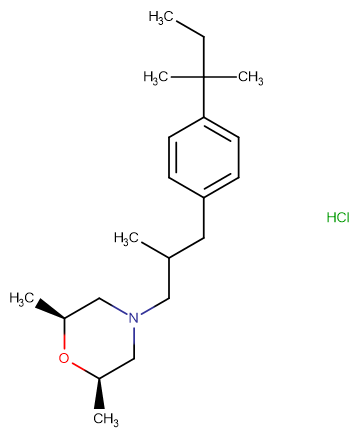
Amorolfine hydrochloride
CAS No. 78613-38-4
Amorolfine hydrochloride( Ro 14-4767/002 )
Catalog No. M15962 CAS No. 78613-38-4
Amorolfine Hydrochloride is an antifungal reagent.
Purity : >98% (HPLC)
 COA
Datasheet
HNMR
HPLC
MSDS
Handing Instructions
COA
Datasheet
HNMR
HPLC
MSDS
Handing Instructions
| Size | Price / USD | Stock | Quantity |
| 50MG | 50 | In Stock |


|
| 100MG | 74 | In Stock |
|
| 200MG | 119 | In Stock |
|
| 500MG | Get Quote | In Stock |
|
| 1G | Get Quote | In Stock |
|
Biological Information
-
Product NameAmorolfine hydrochloride
-
NoteResearch use only, not for human use.
-
Brief DescriptionAmorolfine Hydrochloride is an antifungal reagent.
-
DescriptionAmorolfine Hydrochloride is an antifungal reagent. It exerts the antifungal activity by selectively blocking two steps in the pathway of ergosterol synthesis, and eventually damaging the structure and function of fungal cell membrane. Amorolfine (or amorolfin), is a morpholine antifungal drug that inhibits D14 reductase and D7-D8 isomerase, which depletes ergosterol and causes ignosterol to accumulate in the fungal cytoplasmic cell membranes.(In Vitro):Amorolfine hydrochloride acts primarily by inhibiting ergosterol biosynthesis, a component of fungal cell membrane, and possesses both fungistatic and fungicidal activity.Amorolfine hydrochloride (0-128 mg/l) (2-7 days) shows anti-fungal activity for Dermatophyte fungi, Filamentous fungi, Pathogenic yeasts, Dimorphic fungi, Dematiaceous fungi.Amorolfine hydrochloride shows anti-fungal activity with 90% killing corresponding concentrations of 3, 3, 10 and 100 mg/L for Trichophyton mentagrophytes, C. albicans, Histoplasma capsulatum, Cryptococcus neoformans, respectively.(In Vivo):Amorolfine hydrochloride (0.01%-1%; Intravaginal application; twice daily for 3 days) shows anti-fungal activity in rats with vaginal candidiasis.
-
In VitroAmorolfine hydrochloride acts primarily by inhibiting ergosterol biosynthesis, a component of fungal cell membrane, and possesses both fungistatic and fungicidal activity.Amorolfine hydrochloride (0-128 mg/l) (2-7 days) shows anti-fungal activity for Dermatophyte fungi, Filamentous fungi, Pathogenic yeasts, Dimorphic fungi, Dematiaceous fungi.Amorolfine hydrochloride shows anti-fungal activity with 90% killing corresponding concentrations of 3, 3, 10 and 100 mg/L for Trichophyton mentagrophytes, C. albicans, Histoplasma capsulatum, Cryptococcus neoformans, respectively.
-
In VivoAmorolfine hydrochloride (0.01%-1%; Intravaginal application; twice daily for 3 days) shows anti-fungal activity in rats with vaginal candidiasis. Animal Model:Rats (vaginal candidiasis)Dosage:0.01%-1%Administration:Intravaginal application; twice daily for 3 days Result:Produced a dose dependent log reduction in cell count; a concentration of 1 % cleared the vagina of C. albicans completely.
-
SynonymsRo 14-4767/002
-
PathwayOthers
-
TargetOther Targets
-
RecptorOthers
-
Research AreaInfection
-
Indication——
Chemical Information
-
CAS Number78613-38-4
-
Formula Weight353.97
-
Molecular FormulaC21H36ClNO
-
Purity>98% (HPLC)
-
SolubilityEthanol: 71 mg/mL (200.58 mM); Water: 9 mg/mL (25.42 mM); DMSO: 28 mg/mL (79.1 mM)
-
SMILESCCC(C)(C)C1=CC=C(C=C1)CC(C)CN2C[C@H](O[C@H](C2)C)C.Cl
-
Chemical Name——
Shipping & Storage Information
-
Storage(-20℃)
-
ShippingWith Ice Pack
-
Stability≥ 2 years
Reference
1.Espinel-Ingroff A, et al. Antimicrob Agents ChemOthers. 1984 Jul; 26(1):5-9.
molnova catalog



related products
-
Gemtuzumab
Gemtuzumab(CMA-676) is a monoclonal antibody directed against the CD33 antigen and consists of a recombinant humanized IgG4 antibody.
-
Histamine Phosphate
Histamine acts directly on the blood vessels to dilate arteries and capillaries mediated by both H 1- and H 2-receptors.
-
Cinnamtannin A2
Cinnamtannin A2, a tetrameric procyanidin, enhances GLP-1 and insulin secretion in mice while also upregulating the expression of corticotrophin releasing hormone.
